Every business leader I speak to these days is asking the same question: “Which AI model should we be using?” And honestly, it is one of the most important technology decisions you will make in 2026.
The three names that come up most often are GPT-4 (from OpenAI), Claude (from Anthropic), and Gemini (from Google). Each of them is powerful. Each of them is being used by enterprises right now. But they are not the same and choosing the wrong one for your business can cost you time, money, and competitive ground.
In this guide, I am going to give you a clear, honest, and practical comparison of all three. No jargon. No marketing spin. Just what you actually need to know to make the right decision for your organization.
Let me be upfront: there is no single “best” AI model. The right choice depends entirely on what your business needs to do. What I can do is help you understand where each model excels, where it falls short, and which one is the best fit for your specific use case.
By 2026, choosing an AI model is no longer just a technical decision — it is a strategic one. The wrong choice can slow down your teams; the right one can transform your business.
1. A Quick Overview: Who Built These Models and Why It Matters
GPT-4 — OpenAI
GPT-4 is developed by OpenAI, a company that has arguably done more than anyone to bring AI into the mainstream. OpenAI was founded with a mission to build safe, beneficial AI, and has been at the forefront of the generative AI revolution since the launch of ChatGPT in late 2022.
GPT-4 and its variants (including GPT-4o and the newer GPT-5 series) are widely used across industries. Microsoft has deeply integrated OpenAI technology into its products, including Microsoft 365 Copilot, Azure AI, and GitHub Copilot — which means if your business is already in the Microsoft ecosystem, you are likely already touching GPT-4 in some form.
Claude — Anthropic
Claude is built by Anthropic, a company founded specifically around AI safety research. Several of Anthropic’s founders previously worked at OpenAI before leaving to build a company with a stronger safety-first philosophy.
Claude’s design principles are built around being helpful, harmless, and honest — and this shows in how the model behaves. It is less likely to produce harmful, biased, or misleading content, which matters enormously in enterprise settings where reputational and legal risk is real. The latest generations — Claude Sonnet 4.6 and Claude Opus 4.7 — are widely regarded as the leading models for coding, complex reasoning, and long document analysis.
Gemini — Google DeepMind
Gemini is Google’s flagship AI model, built by Google DeepMind. Google brings something no other AI provider can match: decades of experience in search, data infrastructure, and cloud computing — all deeply integrated into Gemini.
Gemini is natively multimodal, meaning it was designed from the ground up to handle text, images, audio, and video — not as add-ons, but as core capabilities. It is deeply integrated with Google Workspace (Gmail, Docs, Sheets, Meet) and Google Cloud, making it a natural choice for organizations already in the Google ecosystem.
2. How They Compare: The Key Dimensions That Matter for Enterprise
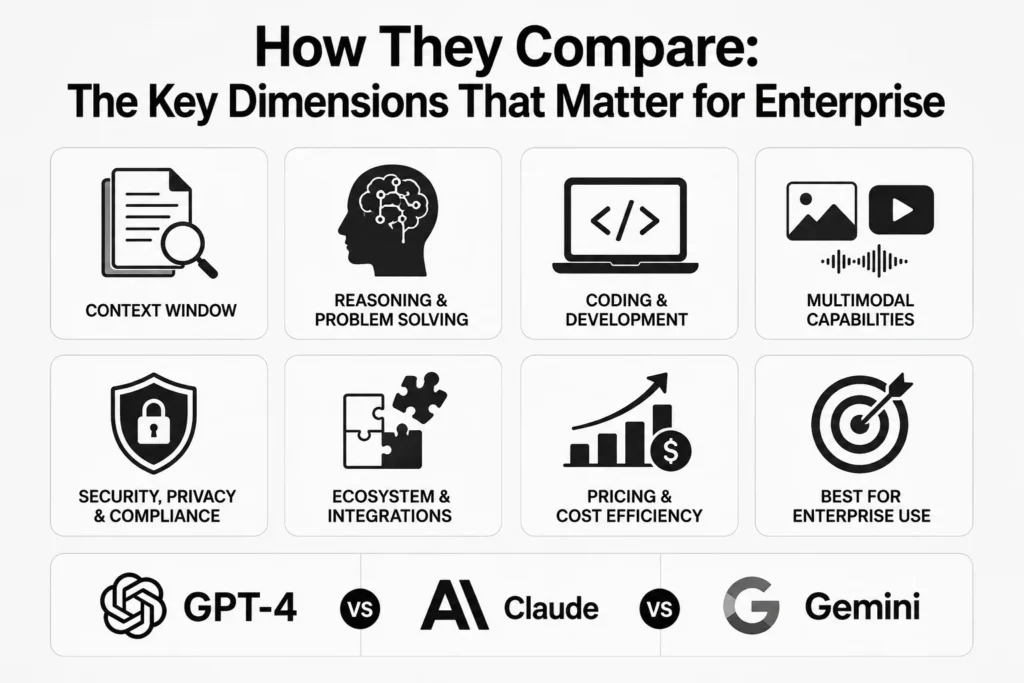
2.1 Context Window: How Much Information Can They Handle at Once?
In enterprise settings, the context window — the amount of text an AI can process in a single interaction — is critically important. Think of it as the AI’s working memory. A larger context window means it can read longer documents, analyse more data, and maintain coherence over longer conversations.
| Model | Context Window | Best For |
| GPT-4o | 128,000 tokens (~96,000 words) | Standard enterprise documents, reports |
| Claude Sonnet 4.6 | 200,000 tokens (~150,000 words) | Long contracts, large codebases, deep analysis |
| Gemini 2.0 Flash | 1,000,000 tokens (~750,000 words) | Entire codebases, multi-hour video transcripts |
If your business regularly works with very long documents — large legal contracts, full codebases, lengthy research reports — Claude and Gemini have a clear advantage. Gemini’s 1 million token context window is in a league of its own for sheer volume, while Claude’s 200,000 token window is the most reliable for sustained deep analysis.
2.2 Reasoning and Complex Problem Solving
For businesses that need AI to tackle genuinely difficult problems — multi-step analysis, strategic planning, financial modelling, legal reasoning — the quality of reasoning matters more than almost anything else.
Claude consistently leads on complex reasoning and coding benchmarks. Its “extended thinking” mode allows the model to reason step by step through difficult problems before giving a final answer — significantly improving accuracy on hard tasks. Claude Sonnet 4.6 and Opus 4.7 both rank at the top of the SWE-bench coding benchmark, which tests AI on real-world software engineering problems.
Gemini leads on certain scientific reasoning benchmarks, particularly in physics and biology. It performs well on complex research tasks, especially when it can pull in real-time data from Google Search.
GPT-4o remains extremely capable and is the most consistent general-purpose model. It may not top every specific benchmark, but it performs reliably across a very wide range of tasks — which is why it remains the most widely deployed model in enterprise environments.
2.3 Coding and Software Development
This is one of the clearest areas of differentiation. If your enterprise has a development team or is building AI-powered software products, this matters a great deal.
Claude is the clear leader in coding. It powers the two most popular AI coding tools used by developers globally — Cursor and Windsurf — and consistently ranks first or second on every major coding benchmark. For writing code, refactoring legacy systems, debugging, or building complex multi-file applications, Claude is the model of choice.
GPT-4o is strong on single-file coding tasks and benefits from its deep integration with GitHub Copilot and the Microsoft developer ecosystem. Gemini 2.5 Pro handles very long codebases well thanks to its massive context window, but tends to trail Claude on raw code generation quality.
For enterprise development teams, Claude’s coding performance is a meaningful competitive advantage — especially for complex, multi-file or repository-level tasks.
2.4 Multimodal Capabilities: Working with Images, Audio, and Video
Modern enterprises do not just work with text. They work with images, diagrams, audio recordings, video content, and more. This is where multimodal capability becomes critical.
Gemini is the strongest multimodal model. It was designed from day one to work across text, images, audio, and video — and it shows. Google Workspace integration means Gemini can analyse a recorded meeting, summarise a presentation, or extract insights from a dataset of images with impressive fluency.
GPT-4o has mature vision and voice capabilities and offers one of the most flexible multimodal stacks available. It handles images and voice input well, making it a strong choice for customer-facing applications.
Claude supports image input and is strong at analysing diagrams, charts, and visual documents — but remains primarily text-and-code-first. It is not the first choice if video or audio processing is a core requirement.
2.5 Security, Privacy, and Compliance
For enterprise buyers, this is often the deciding factor. Sending sensitive business data to an AI model carries real risk — and the security posture of the AI provider matters enormously.
All three providers offer enterprise contracts that exclude customer data from model training and provide data privacy guarantees. But the specifics differ:
- GPT-4 via Azure OpenAI Service offers strong enterprise-grade security, GDPR compliance, SOC 2 certification, HIPAA compatibility, and is deeply integrated with Microsoft’s established enterprise security framework. For regulated industries, Azure is often the trusted choice.
- Claude Enterprise offers robust data privacy, with Anthropic’s safety-first design philosophy embedded in the model itself. Claude is less likely to generate harmful, biased, or legally risky content — a meaningful compliance advantage.
- Gemini Enterprise is FedRAMP-authorised, HIPAA-compliant, ISO-certified, and SOC-certified via Google Cloud’s compliance portfolio. For US federal and public sector organisations, this is particularly important.
If your organisation operates in a heavily regulated sector — financial services, healthcare, legal, or government — all three can meet your compliance needs, but the specific certifications and data residency options should be checked carefully against your requirements.
2.6 Ecosystem and Integrations
An AI model does not work in isolation. It needs to connect with the systems your business already uses. This is where ecosystem fit becomes a major factor.
GPT-4 wins on breadth of integrations. It powers Microsoft 365 Copilot, GitHub Copilot, Azure AI, and integrates with thousands of third-party tools and platforms. If you are a Microsoft-first organization, GPT-4 is the path of least resistance.
Gemini wins on Google ecosystem depth. If your business runs on Gmail, Google Docs, Google Meet, Google Drive, and Google Cloud, Gemini integrates natively and feels seamless. Retrieval-Augmented Generation (RAG) — where the AI searches your own documents to answer questions — feels particularly natural with Gemini and Google Drive.
Claude is API-first and integrates well with custom-built applications. It does not have the same breadth of consumer-facing integrations as GPT-4 or the native Google Workspace depth of Gemini, but its API is clean, reliable, and increasingly supported across the developer ecosystem.
2.7 Pricing: What Does It Actually Cost?
Cost is a real consideration, especially at enterprise scale. Here is a simplified comparison of API pricing as of 2026:
| Model | Input (per 1M tokens) | Output (per 1M tokens) | Best Value For |
| GPT-4o | ~$2.50 | ~$15 | General enterprise, Microsoft ecosystem |
| Claude Sonnet 4.6 | ~$3 | ~$15 | Coding, reasoning, long documents |
| Claude Opus 4.7 | ~$15 | ~$75 | Highest-complexity enterprise tasks |
| Gemini 2.0 Flash | ~$0.10 | ~$0.40 | High-volume, cost-sensitive applications |
| Gemini 3.1 Pro | ~$2 | ~$12 | Premium reasoning at competitive price |
The pricing landscape has a clear takeaway: Gemini Flash is by far the cheapest option for high-volume applications where cost at scale matters. Claude Opus is the most expensive but also the most capable for genuinely complex tasks. Most enterprise architectures in 2026 use a combination — routing simple tasks to cheaper models and complex tasks to premium ones — reducing total AI costs by 40 to 70 percent compared to using a single model for everything.
3. Which Model Should You Choose? A Use Case Guide
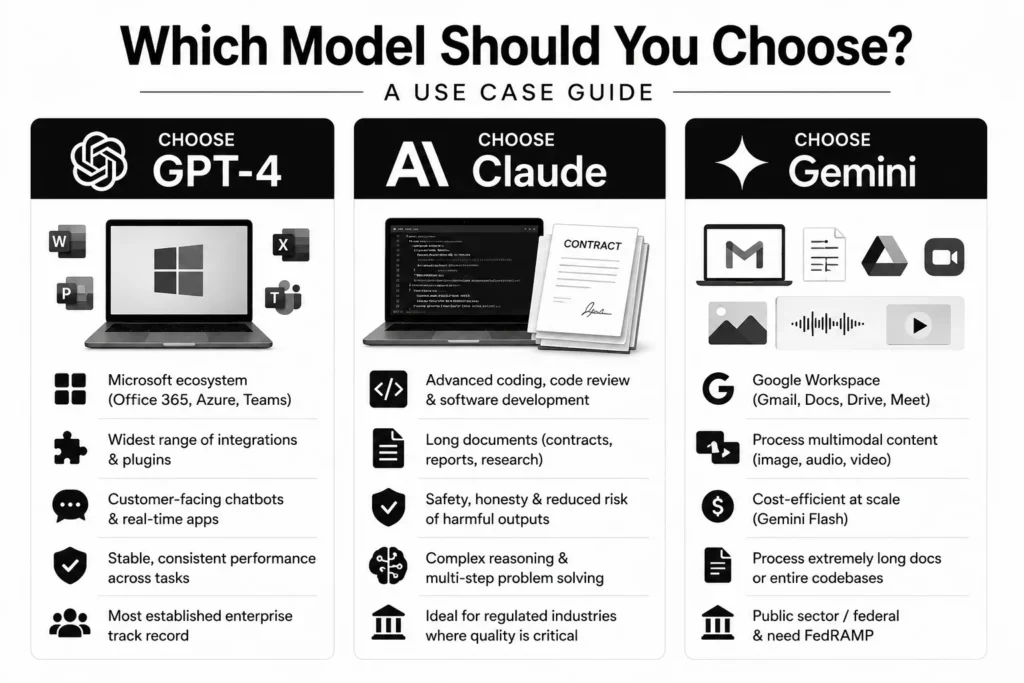
Rather than trying to find one “winner,” the smarter approach is matching the right model to the right task. Here is a practical guide:
Choose GPT-4 / OpenAI if:
- Your business is already deeply embedded in the Microsoft ecosystem (Office 365, Azure, Teams)
- You need the widest range of third-party integrations and plugins
- You are building customer-facing chatbots or real-time interactive applications that need low latency
- Your team needs stable, consistent performance across a very wide range of general tasks
- You want the most established enterprise track record and the largest support community
Choose Claude if:
- Your business needs advanced coding, code review, or software development assistance
- You regularly work with long documents — legal contracts, research papers, financial reports, compliance documentation
- Safety, honesty, and reduced risk of harmful or misleading outputs are non-negotiable
- You are building complex AI-powered applications that require reliable multi-step reasoning
- You work in regulated industries where AI output quality and consistency is critical
Choose Gemini if:
- Your business runs primarily on Google Workspace — Gmail, Docs, Drive, Meet, Sheets
- You need to process multimodal content at scale — images, audio recordings, video transcripts
- Cost at scale is a primary concern and you can leverage Gemini Flash for high-volume tasks
- You need to process extremely long documents or entire codebases in a single context
- You are in the public sector or US federal space and need FedRAMP authorisation
The most sophisticated enterprise AI deployments in 2026 do not pick just one model. They build a multi-model architecture — routing each task to the model best suited to handle it.
4. The Multi-Model Strategy: Why Smart Enterprises Use All Three
Here is something most AI vendor comparisons do not tell you: the best enterprise AI deployments in 2026 are not using a single model. They are using multiple models in parallel, routing tasks intelligently based on complexity, cost, and capability.
Think of it like hiring a team with different specialists rather than one generalist. You would not ask your senior strategist to answer routine customer emails — and you would not ask a junior analyst to lead your most complex board presentation. The same logic applies to AI models.
A typical multi-model enterprise architecture might look like this:
- Simple queries, document classification, and routine data extraction → Gemini Flash (cheapest, fastest)
- Complex reasoning, legal analysis, financial modelling → Claude Sonnet or GPT-4o (high capability)
- Code generation, software debugging, technical documentation → Claude Opus or Sonnet (leading coding performance)
- Multimodal tasks — image analysis, video summarisation → Gemini Pro (strongest multimodal)
- Microsoft 365 workflows, email drafting, meeting summaries → GPT-4 via Copilot (native integration)
Organisations that build this kind of intelligent routing layer report cost reductions of 40 to 70 percent on their total AI infrastructure spend — while actually improving output quality by using the best model for each task.
5. Common Myths About Choosing an AI Model — Debunked
Myth 1: The newest model is always the best choice.
Reality: The newest model is not always the best for your specific use case. Benchmark scores measure general performance — your enterprise has specific workflows with specific requirements. Always test models on your actual use cases before committing.
Myth 2: You must choose one model and stick with it.
Reality: The most successful enterprises use multiple models. With the right API architecture, you can switch models mid-project or route different tasks to different models — and you should.
Myth 3: The cheapest model is fine for everything.
Reality: Using a cheaper model for complex reasoning tasks will produce lower quality outputs that may require significant human review — costing more in the long run than using the right model from the start.
Myth 4: AI model choice is a one-time decision.
Reality: The AI landscape is evolving rapidly. What is the right choice today may not be the right choice in twelve months. Build flexibility into your AI architecture from the start.
6. How to Make the Decision: A Framework for Business Leaders
If you are a business leader trying to make this decision, here is a simple framework I recommend to my clients:
- Map your top 5 AI use cases. What are the specific tasks you want AI to handle in your organisation?
- Assess your existing ecosystem. Are you Microsoft-first, Google-first, or cloud-agnostic?
- Identify your non-negotiables. Is compliance a hard requirement? Is cost the primary constraint? Is coding performance critical?
- Run a structured pilot. Build a test set of 100 to 500 real prompts from your actual workflows. Score each model on accuracy, quality, latency, and cost. Public benchmarks predict only 60 to 70 percent of real-world performance.
- Design for flexibility. Do not lock yourself into one provider’s ecosystem exclusively. Build with APIs that allow you to switch or add models as your needs evolve.
7. Quick Reference: GPT-4 vs Claude vs Gemini at a Glance
| Criterion | GPT-4 (OpenAI) | Claude (Anthropic) | Gemini (Google) |
| Best For | General enterprise, MS ecosystem | Coding, reasoning, long docs | Multimodal, Google Workspace |
| Context Window | 128K tokens | 200K tokens | Up to 1M tokens |
| Coding Performance | Strong | Leading | Good |
| Multimodal | Mature (voice, vision) | Text-and-code-first | Strongest (text, image, video, audio) |
| Safety Focus | Strong | Highest (safety-first design) | Strong |
| Enterprise Compliance | Azure / SOC / HIPAA | Enterprise-grade | FedRAMP / HIPAA / ISO / SOC |
| Cost (flagship) | Mid-range | Mid to Premium | Most cost-effective at scale |
| Ecosystem Fit | Microsoft / Broad | API-first / Custom builds | Google Workspace / GCP |
| Ideal Industries | Any; regulated via Azure | Legal, finance, software, research | Media, education, public sector, tech |
8. Conclusion: The Right Model Is the One That Fits Your Business
If you take one thing from this guide, let it be this: there is no universally “best” AI model for enterprise use. GPT-4, Claude, and Gemini are all excellent — and each is the right answer for a different set of business needs.
GPT-4 is your safest, most versatile choice if you need broad integration, ecosystem fit with Microsoft, and consistent performance across general tasks. Claude is your best choice if coding quality, deep reasoning, long-document analysis, and safety-conscious outputs are your priorities. Gemini is your best choice if you live in the Google ecosystem, need multimodal capabilities, or are running high-volume applications where cost efficiency is critical.
And if you are serious about getting the most from AI in your organisation, consider building a multi-model architecture that leverages the strengths of more than one. The enterprises that will win the next decade are not those that pick the “best” AI — they are those that build the smartest AI strategy.
The AI model you choose is not just a technology decision. It is a strategic statement about how your business plans to compete, innovate, and grow in the decade ahead.
About the Author
Mustasam Abbasi is a Tech Strategy and Digital Transformation Consultant with over 15 years of experience advising global enterprises, including Jaguar Land Rover. He works with startups and organisations across the UK, Pakistan, and the Middle East to help them build smarter, more competitive businesses through technology. Visit mustasamabbasi.com or connect on LinkedIn.