Imagine waking up one morning to discover that the algorithm not your marketing team now decides whether your content ever reaches a single viewer. That moment isn’t coming. For millions of Media & Entertainment companies, it has already arrived.
The rise of AI-powered personal assistants has fundamentally shifted content discovery away from traditional media platforms and into the hands of intelligent agents that curate, recommend, and serve content on behalf of the consumer. Studio giants, independent publishers, and streaming services are all grappling with the same uncomfortable reality: if your content isn’t optimized for AI-driven discovery, it may simply go unseen regardless of its quality. This is not a distant disruption; it is a structural change reshaping the entire media value chain right now.
96%
of M&E marketers are now expected to directly drive revenue
94%
of executives see AI-driven streaming recommendations as a loyalty driver
34%
reduction in content costs reported by firms using AI workflow automation
14%
of M&E firms say they are truly ready for AI-driven content creation
The Shift in Content Discovery: What Has Changed?
For decades, media companies controlled the discovery funnel they owned the homepage, the recommendation engine, the editorial calendar, and the subscriber relationship. AI-powered personal assistants have broken that model. When a consumer asks their AI assistant “what should I watch tonight?”, the answer is generated by an algorithm trained on behavioral data, not by a marketing campaign or a carefully crafted content slate.
The locus of influence has moved upstream, and media companies that fail to adapt will find themselves disintermediated from the very audiences they worked so hard to build.
This shift carries profound implications for content marketing strategy. Organic traffic the lifeblood of publisher monetization is eroding as agentic interfaces absorb the first touchpoint of user intent. Marketers must now think in two parallel tracks: optimizing for human audiences and simultaneously structuring content so that AI systems can surface, evaluate, and recommend it accurately.
This requires:
- Investment in metadata architecture
- Semantic content tagging
- Performance data pipelines
It also demands a new breed of marketer — one fluent in both creative storytelling and data-driven content infrastructure.
Content Relevance: Turning Archives into Living Ecosystems
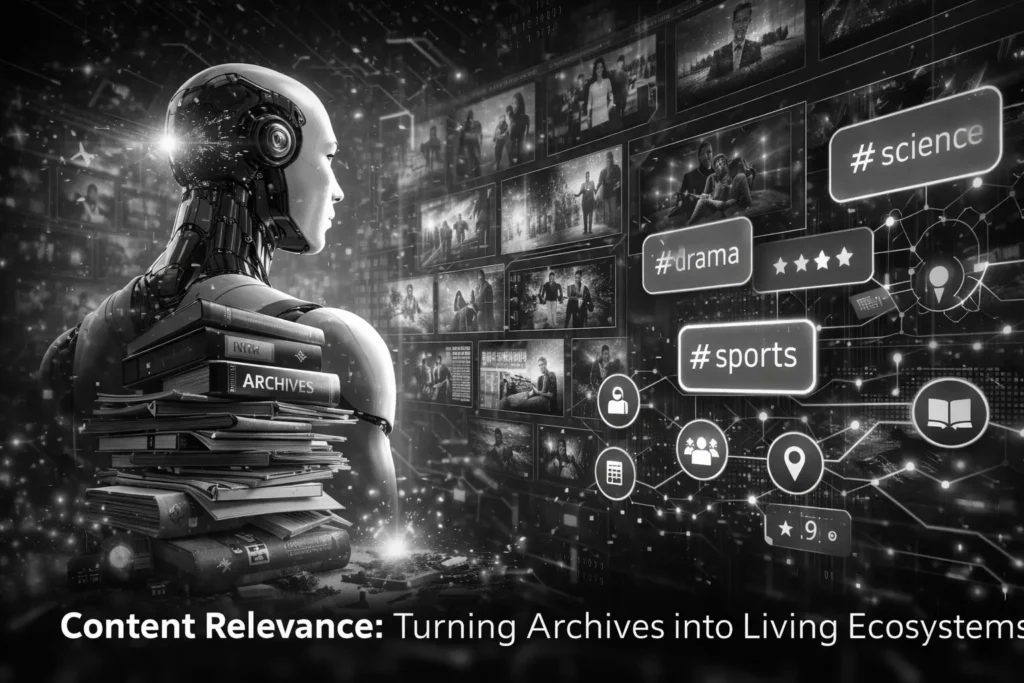
Most media companies are sitting on a goldmine they cannot access.
Vast content libraries spanning decades remain locked in static archives, invisible to modern recommendation engines because they lack the structured metadata needed to surface them intelligently.
AI-driven content enrichment changes this entirely.
By applying intelligent tagging across:
- Creative attributes
- Contextual signals
- Historical performance data
Every asset becomes:
- Searchable
- Recommendation-ready
- Monetizable
A documentary produced five years ago can suddenly become the most relevant recommendation for a viewer in a new geography simply because AI can now match it to emerging interest patterns at scale.
The results are measurable:
- Nearly 2× content output
- Reduced manual curation costs
- Faster time-to-activation
“Companies using AI for managing content and automating workflows have seen a 34% reduction in content costs and nearly double the amount of output.”
Adobe State of Customer Experience in Media & Entertainment Report
Platform Relevance: One Creative Concept, Infinite Variations
Creative teams have long been burdened by adapting campaigns across multiple platforms, formats, and languages.
AI-powered content versioning removes this bottleneck.
From a single master creative, AI can generate:
- Hundreds of variations
- Platform-specific formats
- Language adaptations
This allows creative teams to focus on:
- Concept development
- Emotional storytelling
- Brand identity
Performance Impact:
- Faster A/B testing
- Higher conversion rates
- Improved click-through rates
- Better audience targeting
Reduced production costs also mean more budget can be allocated to premium creative and strategic media investment.
AI Use Cases & Business Impact
| AI Use Case | Key Benefit | Business Impact |
| Metadata enrichment & tagging | Searchable, recommendation-ready content | ~2× output; lower costs |
| Automated content versioning | Rapid adaptation | Faster go-to-market |
| AI-driven A/B testing | Real-time optimization | Higher engagement |
| Localization automation | Global scale delivery | Up to 50% efficiency gain |
| Personalized recommendations | Tailored user journeys | Higher loyalty, lower churn |
Global Relevance: Localizing at the Speed of AI
Global distribution has traditionally been expensive and slow.
AI-powered localization is changing that.
Tasks like:
- Translation
- Subtitling
- Dubbing
- Cultural adaptation
are now completed in hours instead of weeks.
Human roles shift toward:
- Quality control
- Cultural sensitivity
- Tone validation
Impact:
- Up to 50% efficiency gains
- Faster international expansion
- Scalable global content strategies
AI transforms localization from a bottleneck into a competitive advantage.
Building a Scalable AI-Ready Content Platform: Five Non-Negotiables
Only 14% of M&E firms are truly ready for AI at scale.
Technology alone is not enough. Foundations matter.
Five critical capabilities:
- Reimagine workflows
AI should augment creativity, not replace it - Modular content design
Break content into reusable components - Strong metadata architecture
Ensure discoverability and activation - Compliance systems
Automate legal and brand safeguards - Continuous feedback loops
Use performance data to improve AI systems
Without these, AI amplifies inefficiencies instead of solving them.
What This Means for Marketers: A New Operating Model
Marketing is undergoing a structural transformation.
The modern marketer must now handle:
- Data strategy
- AI governance
- Content operations
- Technology integration
Success requires operating at the intersection of:
- Creativity
- Analytics
- Systems thinking
For executives, the message is clear:
AI is no longer optional.
Organizations that invest in:
- AI-native infrastructure
- Data ecosystems
- Talent development
will:
- Expand content value
- Accelerate growth
- Increase revenue
Those that delay risk becoming invisible in an AI-driven discovery landscape.
A Global Leader in Tech Innovation & Social Impact
Driving Global Innovation with Purpose
From award-winning automotive technology to startup mentorship and social impact programs turning bold ideas into measurable results across industries and continents.
30+ Clients & Partners
40+ Strategic Projects Delivered
10+ Countries Worked In
2023 – Mentor of the Year — Startup Pakistan
2020 – Digital Inclusion Pioneer — UK Social Impact Fund
2018 – Middle East Business Leader Award
FAQs
1. How is AI changing content discovery in media and entertainment?
AI shifts content discovery from platform-controlled systems to algorithm-driven recommendations, where intelligent agents decide what users see based on behavior and preferences.
2. Why is metadata important for AI-driven content discovery?
Metadata enables AI systems to understand, categorize, and recommend content accurately. Without structured metadata, even high-quality content may remain undiscovered.
3. What are the biggest benefits of AI in content marketing?
AI improves efficiency, reduces costs, enables personalization, accelerates content production, and enhances performance through real-time optimization.
4. Can AI replace creative teams in media companies?
No. AI enhances productivity by handling repetitive tasks, but human creativity remains essential for storytelling, emotional connection, and brand identity.
5. What should companies prioritize to become AI-ready?
Organizations should focus on clean data, strong metadata frameworks, scalable workflows, compliance systems, and continuous performance feedback loops.