Why AI’s Future Is Built in the Physical World
Artificial intelligence is often discussed in abstract terms models, algorithms, and exponential capability curves. Yet behind every large-scale AI deployment lies a far more grounded reality: physical infrastructure, energy availability, critical minerals, secure supply chains, and operational discipline. Recent conversations at global forums like Davos have reinforced a simple truth AI progress depends as much on execution and leadership as it does on innovation.
As organizations race to adopt AI, many overlook the foundational layers that determine whether systems can scale reliably, ethically, and securely. From data centers and energy grids to mobility systems and national security considerations, AI readiness is no longer a purely digital challenge. It is an operational one.
The Physical Layer of AI: What Actually Enables Scale
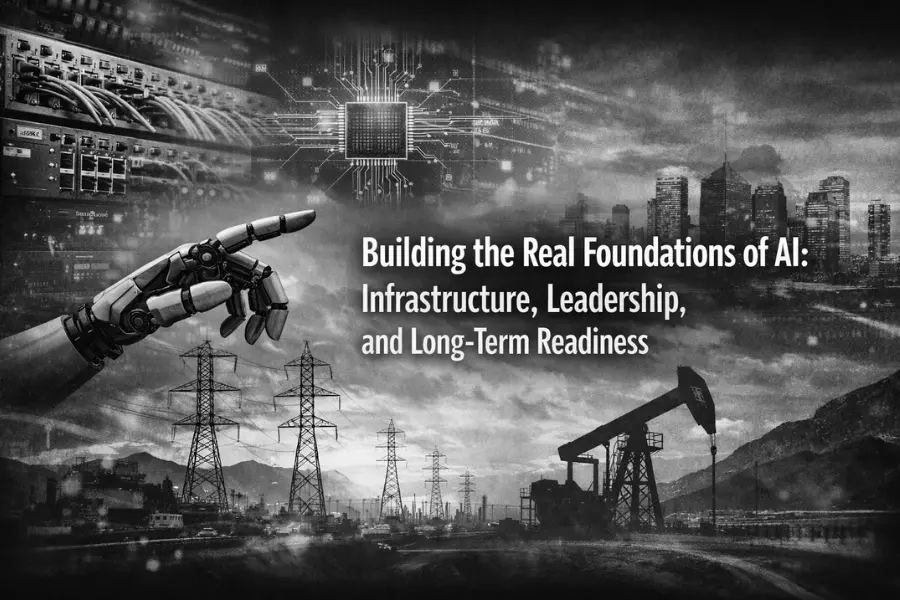
At its core, AI is an infrastructure-intensive technology. Large language models, autonomous systems, and real-time analytics demand massive computational power, resilient networks, and dependable energy sources. These requirements place unprecedented pressure on existing systems and force organizations to think beyond software.
Critical minerals such as lithium, cobalt, and rare earth elements underpin hardware manufacturing. Energy availability determines where AI clusters can realistically operate. Physical security and redundancy dictate resilience. Without these components, even the most advanced AI strategies remain theoretical.
For leaders and investors, this shifts the conversation from “What can AI do?” to “What can our infrastructure support?” That question is increasingly shaping competitive advantage.
Why Leadership Experience Matters in AI and Emerging Technologies
Successfully navigating AI transformation requires more than technical expertise. It demands seasoned leadership with experience across business development, operations, product delivery, and organizational change. Over two decades of working across B2B software, services, product development, quality engineering, start-up advisory, and vehicle launch programs reveals a consistent pattern: technology succeeds only when strategy, execution, and people align.
Leaders who have operated across multiple industries understand how to translate innovation into measurable outcomes. They recognize risk early, balance ambition with feasibility, and build systems that endure beyond initial pilots. This perspective is especially critical in AI, where hype often outpaces readiness.
Global Operations and Cross-Functional Execution at Scale
AI infrastructure is inherently global. Supply chains span continents, regulatory frameworks vary by region, and deployment environments differ widely. Experience leading large, cross-functional teams across the United States, Europe, the Middle East, China, and India provides an essential advantage in this landscape.
Such exposure enables leaders to anticipate friction points whether cultural, regulatory, or operational and design strategies that work across borders. AI systems deployed in mobility, healthcare, finance, or security contexts cannot afford regional blind spots. Global execution experience ensures consistency, compliance, and resilience.
Quantum Readiness Starts with Operational Discipline
Quantum computing is often framed as a future leap that will redefine AI and security. While that may be true, quantum readiness begins today with fundamentals: data governance, infrastructure robustness, cybersecurity maturity, and systems thinking.
Organizations that struggle with current AI deployments will not suddenly become quantum-ready. Preparing for quantum impact requires disciplined operations, modular architectures, and leadership that understands both emerging technology and real-world constraints. The future belongs to those who prepare methodically, not those who chase headlines.
Mobility, AI, and Security: An Increasingly Connected Ecosystem
Mobility systems autonomous vehicles, smart logistics, connected infrastructure sit at the intersection of AI capability and physical reality. These systems rely on real-time decision-making, edge computing, and secure communication networks. Failure in any layer can have safety, economic, and security consequences.
Experience in vehicle launch programs and complex engineering environments provides critical insight into how AI must perform under real-world conditions. Unlike consumer software, mobility and security systems demand reliability, explainability, and rigorous testing. AI leadership in these domains is as much about governance and quality as it is about innovation.
Supporting Start-Ups Beyond the Pitch Deck
Start-ups often possess exceptional ideas but lack the operational maturity to scale responsibly. Advisory experience across product development, quality engineering, and go-to-market execution enables founders to bridge that gap.
Effective start-up enablement goes beyond funding and vision. It involves building scalable architectures, aligning product roadmaps with infrastructure realities, and preparing organizations for enterprise and regulatory scrutiny. Advisors with hands-on operational backgrounds help founders avoid costly missteps and accelerate sustainable growth.
Strategy, Belief, and Execution: Driving Meaningful Change
Driving transformation whether in AI, mobility, or enterprise software requires more than strategy documents. It requires belief, motivation, commitment, and disciplined practice. Leaders who have consistently delivered results understand how to align teams around purpose while maintaining execution rigor.
Strong communication skills and client presence play a critical role in this process. They enable trust, clarity, and momentum across stakeholders with competing priorities. In AI initiatives, where uncertainty is high, these leadership qualities often determine success or failure.
A Pragmatic and Diplomatic Approach to Stakeholder Influence
AI initiatives touch regulators, customers, engineers, investors, and society at large. Navigating these interests demands a diplomatic yet pragmatic approach. Progress depends on listening carefully, negotiating trade-offs, and building consensus without losing momentum.
Continual development of stakeholder influencing skills is essential in this environment. The most effective leaders evolve constantly, refining how they engage, persuade, and lead through complexity.
Technology Leadership with Social Responsibility
As AI reshapes industries, leaders have a responsibility to consider social impact alongside commercial outcomes. Engagement as a philanthropist and board member for multiple charities reflects a commitment to using expertise and influence for broader good.
Responsible AI leadership recognizes that technology decisions affect communities, workforces, and future generations. Integrating ethical considerations into strategy is no longer optional it is foundational to long-term trust and sustainability.
Services That Enable Scalable, Responsible Innovation
Organizations navigating AI and digital transformation benefit from integrated capabilities across technology and management. Key service areas include:
- Application Development
- Business Analytics
- Custom Software Development
- Database Development
- Enterprise Content Management
- Mobile Application Development
- SaaS Development
- Software Testing and Quality Engineering
- Project and Program Management
- Management Consulting
These services, when delivered with strategic oversight and operational discipline, enable organizations to move from concept to scale with confidence.
Let’s Connect

If this perspective resonates, Mustasam Akhtar Abbasi welcomes thoughtful conversations with founders, enterprise leaders, and changemakers who are focused on building technology that delivers real, lasting impact.
Whether the discussion is around AI infrastructure, quantum readiness, mobility, or large-scale digital transformation, meaningful outcomes often begin with an open exchange of ideas.
Feel free to leave a comment, reach out directly, or connect to continue the conversation.
Conclusion: Building What Actually Lasts
AI’s future will not be determined by ambition alone. It will be shaped by infrastructure readiness, operational leadership, and the ability to execute responsibly across global systems. As conversations at Davos increasingly reflect, the most meaningful progress happens when innovation meets grounded, practical execution.
Organizations that invest in real-world foundations energy, infrastructure, people, and governance will define the next era of AI, mobility, and security. The rest will continue to chase potential without realizing it.
FAQs
1. Why is AI infrastructure as important as AI algorithms?
AI algorithms rely on physical systems such as data centers, energy grids, networks, and hardware supply chains. Without resilient infrastructure, AI solutions cannot scale securely, reliably, or sustainably.
2. How does leadership experience impact successful AI transformation?
AI transformation requires strategic clarity, operational discipline, and people leadership. Leaders with cross-functional and global experience are better equipped to translate innovation into measurable business and societal outcomes.
3. What is meant by “quantum readiness” in today’s organizations?
Quantum readiness refers to preparing systems, data governance, cybersecurity, and infrastructure so organizations can adapt when quantum computing becomes commercially viable, rather than reacting too late.
4. How do AI, mobility, and security intersect?
Modern mobility systems rely on AI for real-time decision-making, while security ensures safety, data integrity, and resilience. These domains are deeply interconnected and must be designed together, not in isolation.
5. How can start-ups benefit from operational and strategic advisory?
Start-ups gain value from advisors who understand scaling challenges, quality engineering, global markets, and enterprise expectations—helping them avoid costly mistakes and accelerate sustainable growth.