Artificial Intelligence is evolving and fast. Just a couple of years ago, most businesses were amazed by chatbots that could answer questions, write emails, or summarize documents. That was the era of generative AI. But by 2026, something far more powerful has taken center stage: Agentic AI.
This is not just a new buzzword. Agentic AI represents a fundamental shift in how machines work. Instead of waiting for you to ask a question, these AI systems take initiative. They set goals, make plans, take actions, and complete entire workflows on their own with minimal human involvement.
In this blog post, we will break down everything you need to know about Agentic AI in plain, simple language. Whether you are a CEO, startup founder, or a team leader, this guide will help you understand what Agentic AI is, why it matters, how it is being used in real businesses today, and how you can start using it strategically.
By 2026, Agentic AI is no longer a concept for the future. It is happening right now — and businesses that understand it early will have a serious competitive advantage.
1. From Reactive AI to Autonomous AI: What Changed?
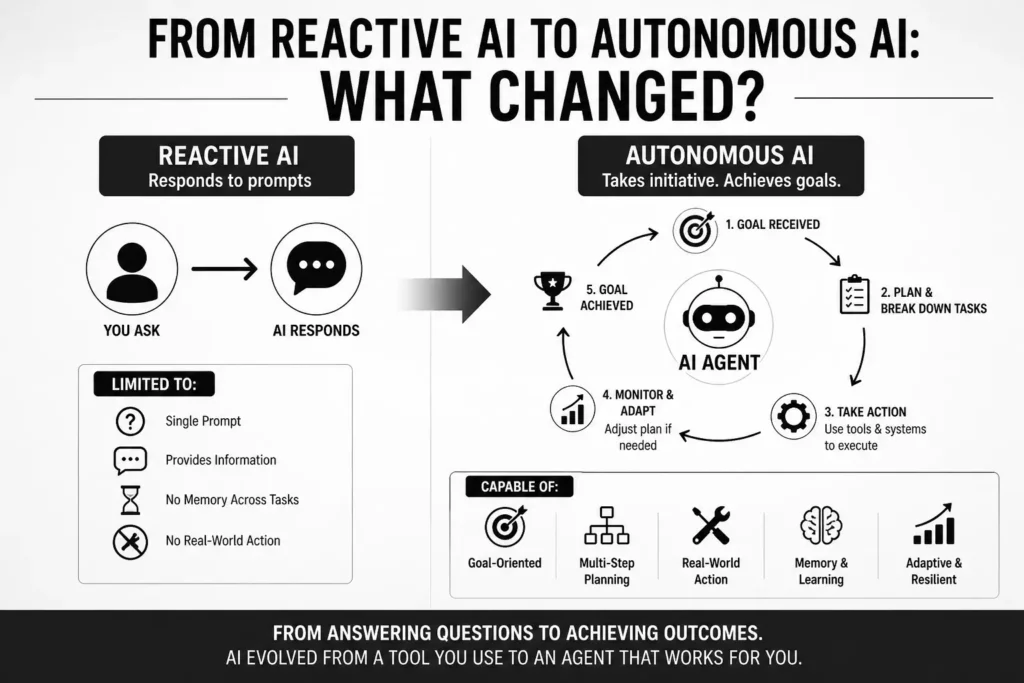
To understand Agentic AI, it helps to understand what came before it.
Traditional AI tools including most generative AI tools like the early versions of ChatGPT — were reactive. That means they responded to what you asked. You type a prompt, the AI gives you an answer. Simple. Useful. But limited.
Agentic AI is different. It is proactive and autonomous. Instead of responding to a single prompt, an agentic AI system:
• Receives a high-level goal (e.g., “Increase customer retention by 10% this quarter”)
• Breaks that goal into smaller tasks
• Plans the steps needed to complete each task
• Uses tools and systems to actually execute those steps
• Monitors progress and adjusts the plan if something goes wrong
Think of it this way: a generative AI is like a very smart assistant who answers your questions. An agentic AI is like a very capable employee who takes ownership of a project from start to finish.
Agentic AI shifts businesses from reactive generative AI tools to autonomous, goal-oriented agents that act, plan, and use tools to achieve outcomes.
2. Key Characteristics of Agentic AI
So what exactly makes an AI system “agentic”? There are four core characteristics that define Agentic AI:
2.1 Autonomy
Agentic AI systems can operate independently. Once given a goal, they do not need constant instructions from a human. They figure out what needs to be done and get on with it. Human intervention is only required for high-risk or sensitive decisions and even that can be set by you in advance.
This level of autonomy means you can delegate entire workflows to AI, freeing up your team to focus on strategy, creativity, and human relationships.
2.2 Planning and Reasoning
One of the most impressive features of Agentic AI is its ability to reason through problems. It does not just react it thinks ahead.
When given a complex goal, an agentic system will decompose it into a structured, step-by-step plan. It considers dependencies (“I need to do X before Y”), alternatives (“If Plan A fails, try Plan B”), and timelines. This kind of multi-step planning was once only possible with a skilled human project manager.
2.3 Tool Use and Action-Taking
Agentic AI is not just a text generator. It connects to real systems through APIs (Application Programming Interfaces) and takes actual actions in the real world. For example, an agentic AI can:
• Send emails on your behalf
• Update records in your CRM (Customer Relationship Management) software
• Search the internet for live data
• Book meetings in your calendar
• Manage and optimize supply chain systems
• Write and deploy code
This ability to take action not just generate text is what makes Agentic AI truly transformative. It closes the gap between “thinking” and “doing.”
2.4 Memory and Learning
Unlike simple AI tools that forget everything once a conversation ends, Agentic AI systems maintain memory across long workflows. They remember what they have done, what worked, and what did not.
Over time, they learn from feedback and improve their performance. This makes them increasingly effective the longer they are deployed a major advantage for businesses looking for long-term value from their AI investment.
3. Why Does This Matter for Business Leaders?
Here is the number that should get your attention:
Agentic AI improves business efficiency by 30 to 50 percent across complex, multi-step workflows.
That is not a small improvement. For most organizations, that kind of efficiency gain would be transformational. But the impact goes beyond just saving time.
Here is why Agentic AI is critical for business leaders in 2026:
• Scale without headcount growth: Agentic AI can handle tasks that would normally require large teams, allowing businesses to scale operations without proportionally increasing staff.
• Faster decision cycles: When AI can gather data, analyze it, and generate recommendations autonomously, decisions that used to take days can be made in hours.
• Reduced human error: Repetitive, rule-based tasks (like data entry, compliance checks, or invoice processing) are prone to human error. Agentic AI handles these with consistency and precision.
• Competitive differentiation: Early adopters of Agentic AI will be able to move faster, serve customers better, and operate more efficiently than competitors still relying on manual or semi-automated processes.
4. Real-World Business Use Cases in 2026
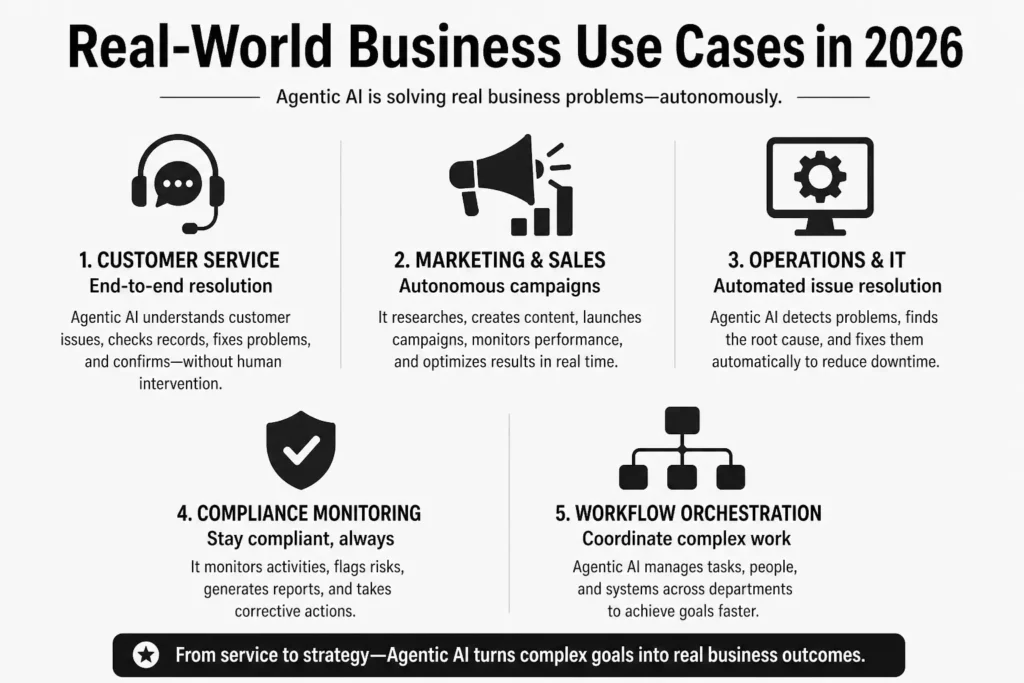
Agentic AI is not just theory. Businesses across industries are already deploying agentic systems in meaningful ways. Here are the most impactful use cases:
4.1 Customer Service: End-to-End Resolution
Traditional AI in customer service could help draft a response. Agentic AI goes much further. It can resolve an entire customer complaint from start to finish without a human touching it.
For example, if a customer contacts a telecom company about an incorrect bill, an agentic AI can:
1. Identify the customer and access their account
2. Understand the complaint using natural language
3. Check billing records and detect the error
4. Apply the correction directly in the billing system
5. Notify the customer with a confirmation
This is not just automation it is intelligent, multi-step problem-solving at scale.
4.2 Marketing and Sales: Autonomous Campaign Management
Agentic AI is transforming marketing by handling entire campaign lifecycles autonomously. It can research your audience, generate targeted content, launch campaigns across multiple channels, monitor performance in real time, and adjust budgets and messaging based on what is working.
This means marketing teams can focus on brand strategy and creative direction while AI handles the operational heavy lifting.
4.3 Operations and IT: Automated Incident Resolution
In IT and operations, downtime is expensive. Agentic AI can monitor systems continuously, detect anomalies, diagnose the root cause of an issue, and in many cases resolve it automatically — all before a human engineer has even been notified.
In supply chain management, agentic systems can optimize inventory levels, reroute shipments in response to disruptions, and coordinate with suppliers all in real time.
4.4 Compliance Monitoring
Regulatory compliance is a growing burden for businesses, especially in sectors like finance, healthcare, and data privacy. Agentic AI can continuously monitor transactions, communications, and processes for compliance risks, flag issues, generate reports, and in some cases take corrective action.
This dramatically reduces the risk of regulatory penalties while freeing compliance teams to focus on interpretation and strategy rather than manual monitoring.
4.5 Workflow Orchestration
Perhaps the most powerful use case is workflow orchestration where Agentic AI coordinates multiple systems, teams, and processes to complete a complex, cross-functional objective.
For example, launching a new product might involve coordinating between product development, legal, finance, marketing, and sales. An agentic orchestrator can manage the dependencies, timelines, and handoffs across all of these acting like a super-efficient project manager who never sleeps.
5. Agentic AI vs. Traditional Automation vs. Generative AI
It is helpful to understand how Agentic AI compares to what came before it:
| Feature | Traditional Automation | Generative AI | Agentic AI |
| Goal-Setting | No | No | Yes |
| Planning | No | Limited | Yes |
| Action-Taking | Rule-based only | No | Yes |
| Memory | No | Short-term | Long-term |
| Handles Complexity | Low | Medium | High |
| Learning Over Time | No | No | Yes |
6. The Human-in-the-Loop Principle: AI That Works With You
One of the biggest concerns leaders have about autonomous AI is: “What if it makes a mistake?” This is a valid concern — and it is why the Human-in-the-Loop (HITL) principle is central to responsible Agentic AI deployment.
Well-designed agentic systems are built with clear boundaries. For low-risk, routine tasks, the AI acts independently. For high-stakes decisions — like approving a major contract, managing a crisis, or making a public statement — the AI pauses, presents its recommendation, and waits for human approval.
This means you are not giving up control. You are giving AI the freedom to handle the routine, while keeping humans in charge of the consequential. The result is the best of both worlds: speed and accuracy at scale, with human judgment where it matters most.
The most effective Agentic AI deployments are not about replacing humans — they are about freeing humans to do what only humans can do.
7. Strategic Implementation: How to Get Started with Agentic AI
If you are a business leader thinking about adopting Agentic AI, here is a practical framework to guide your journey:
Step 1: Identify High-Impact Use Cases
Start by mapping your workflows and identifying the tasks that are:
• Time-consuming and repetitive
• Rule-based but complex (involving multiple steps or systems)
• Currently creating bottlenecks in your operations
These are your prime candidates for agentic automation. Do not try to automate everything at once — start where the impact will be highest and the risk is manageable.
Step 2: Prioritize Governance and Security
Agentic AI systems take real actions in real systems. This means strong governance is non-negotiable. Before deploying, ensure you have:
• Clear audit logs so every action the AI takes can be reviewed
• Access controls that limit what systems the AI can interact with
• Security protocols that protect against unauthorized access or data breaches
• Compliance checks built into every workflow
Governance is not a barrier to Agentic AI adoption — it is the foundation that makes safe adoption possible.
Step 3: Design Human-in-the-Loop Workflows
For every agentic workflow you design, define clearly where humans will stay in the loop. Ask yourself:
• At what decision points do we need human approval?
• What actions should the AI never take without explicit authorization?
• How will we monitor performance and catch errors?
This design thinking will build trust in the system — both within your organization and with your customers.
Step 4: Invest in Skills Evolution
Agentic AI does not eliminate jobs — but it does change them. Your team will need new skills to work effectively in an AI-augmented environment. New roles are emerging, such as:
• AI Workflow Designer — someone who maps out and designs agentic workflows
• Agent Performance Analyst — someone who monitors AI performance and optimizes behavior
• AI Ethics and Compliance Officer — someone who ensures agentic systems operate within legal and ethical boundaries
Invest in training your existing team to take on these roles. This is both a retention strategy and a competitive advantage.
Step 5: Start Small, Learn Fast, Scale Smart
The biggest mistake businesses make with new technology is trying to boil the ocean. Start with one well-defined use case. Run a pilot. Measure the results. Learn from what works and what does not. Then scale.
This iterative approach reduces risk and builds internal confidence in Agentic AI as a real, reliable tool for your business.
8. The Shift from Reactive to Proactive: A Strategic Mindset Change
Perhaps the most important thing to understand about Agentic AI is what it signals about the future of business.
We are moving from a world where AI is a tool you use to a world where AI is a collaborator that works alongside you. From reactive (answering questions) to proactive (achieving outcomes). From task-level to goal-level.
This is not just a technology upgrade — it is a strategic mindset change. Leaders who continue to think of AI as a productivity tool will miss the bigger opportunity. Leaders who think of Agentic AI as a strategic capability will build organizations that are faster, smarter, and more resilient.
The Harvard Business Review describes this as a profound shift in human-AI collaboration — one that redefines the nature of work itself. And this shift is already underway.
We are not just automating tasks. We are creating intelligent systems that can pursue goals, learn from experience, and drive business outcomes at a scale humans alone could never achieve.
9. Common Myths About Agentic AI — Debunked
As with any transformative technology, Agentic AI comes with its share of misconceptions. Let us clear up a few:
Myth 1: “Agentic AI will replace my entire workforce.” Reality: Agentic AI automates tasks, not roles. It takes over the routine so your people can focus on the strategic. Most organizations that adopt Agentic AI find that it creates new, higher-value roles.
Myth 2: “It is only for large enterprises.” Reality: Agentic AI tools are becoming increasingly accessible and affordable. Startups and SMEs can and are already benefiting from agentic workflows.
Myth 3: “It is too risky to trust AI with real actions.” Reality: With proper governance, audit trails, and human-in-the-loop design, Agentic AI can be deployed safely and responsibly. The risk of not adopting it — falling behind competitors — may be greater.
Myth 4: “We need to wait until the technology matures.” Reality: The technology is mature enough for meaningful deployment today. Waiting only means losing ground to those who are already using it.
10. Conclusion: The Future Is Agentic
Agentic AI represents the next major leap in the evolution of artificial intelligence — and it is happening right now, in 2026.
For business leaders, the question is no longer “Should we explore Agentic AI?” The question is: “How quickly can we adopt it thoughtfully and strategically?”
The businesses that will win in the next five years are those that learn to combine human creativity, judgment, and empathy with the autonomous capability, speed, and scale of Agentic AI. Those who get this combination right will not just be more efficient — they will be genuinely more powerful organizations.
Start by identifying one high-impact use case. Build in strong governance. Keep humans in the loop where it matters. And invest in the skills your team will need to thrive alongside AI agents.
The shift from reactive to proactive, from task-level to goal-level, from tool to collaborator — that shift is already underway. The only question is whether your organization will lead it or catch up to it.
Agentic AI is not the future of work. It is the present. And the leaders who embrace it now will define the future.
About the Author
Mustasam Abbasi is a Tech Strategy and Digital Transformation Consultant with over 15 years of experience working with global enterprises including Jaguar Land Rover. He advises startups and organizations across the UK, Pakistan, and the Middle East on how to innovate with purpose. Connect on LinkedIn or visit mustasamabbasi.com.