What if the way you learned to read, write, and study becomes obsolete within a decade? AI in education 2026 is not a futuristic concept it’s a present-day transformation reshaping classrooms, universities, and professional training programs worldwide. From AI-powered reading assistants to automated writing tools and personalized learning platforms, the foundation of traditional education is shifting fast. Schools that recognize this shift early will unlock massive advantages in student performance and digital literacy. Those that ignore it risk becoming irrelevant in a rapidly evolving knowledge economy.
Reading in the Age of AI: A Silent Revolution
Reading is no longer limited to printed pages or even static digital screens. Today’s students consume knowledge through audiobooks, AI-generated summaries, interactive transcripts, and smart assistants that explain complex texts instantly. This evolution in digital learning transformation reflects broader changes in attention spans, technology adoption, and content accessibility. AI tools now allow students to ask questions about a book and receive contextual explanations within seconds. The shift isn’t about abandoning reading it’s about redefining how information is absorbed.
Traditional reading required deep focus and linear progression, but AI-enhanced reading allows nonlinear exploration of ideas. Learners can jump directly to key insights, clarify difficult passages, and even simulate discussions around a text. This creates efficiency but also raises concerns about critical thinking and comprehension depth. Educational institutions must now reconsider what “reading proficiency” truly means. The goal is no longer just finishing a book it’s understanding and applying knowledge effectively.
The Rise of AI-Powered Content Consumption
The explosion of AI reading tools has fundamentally changed how students interact with information. Platforms that generate summaries, extract key themes, and provide contextual analysis are increasingly common in classrooms and workplaces. This growth in AI-powered learning platforms signals a broader move toward on-demand knowledge. Instead of spending hours reviewing a chapter, learners can now gain core insights in minutes. Efficiency is the primary driver of this transformation.
However, speed does not always equal mastery. While AI tools improve accessibility and reduce barriers, they can also encourage surface-level engagement. Institutions must strike a balance between leveraging AI for productivity and maintaining deep analytical thinking. Teaching students how to evaluate AI-generated content critically is becoming as important as teaching them how to read. The future of education lies in blending technological convenience with intellectual rigor.
Student Shortcuts: From Study Guides to Smart AI
Students have always looked for faster ways to complete assignments. Study guides, summaries, and explainer videos existed long before artificial intelligence entered the classroom. What AI has done is compress the shortcut timeline from hours to seconds. With a simple prompt, learners can generate outlines, key arguments, or thematic analyses instantly. This marks a dramatic shift in education technology trends.
The challenge for educators is not stopping shortcuts it is redesigning learning experiences. When AI can generate a perfect essay draft, assessment models must evolve beyond memorization. Schools should prioritize project-based learning, collaborative problem-solving, and real-world application tasks. By adapting to AI rather than resisting it, institutions can turn potential academic dishonesty into an opportunity for deeper engagement. This is where strategic AI integration in schools becomes essential.
How AI Is Transforming Writing Skills
If reading habits are evolving, writing practices are undergoing even greater disruption. AI writing tools now assist with grammar, structure, tone, and idea development in real time. Students and professionals alike are using AI to draft reports, essays, and marketing materials faster than ever. This acceleration directly impacts the future of learning and communication. Writing is no longer just about producing text it is about directing intelligent systems effectively.
The key skill is shifting from manual composition to critical editing and idea refinement. Students must learn how to prompt AI strategically, verify outputs, and inject originality into generated drafts. Rather than replacing writers, AI redefines the writing workflow. Institutions that integrate AI literacy into curricula will prepare students for modern careers. The emphasis moves from writing every word independently to managing the creative process intelligently.
Textbooks and the End of One-Size-Fits-All Learning
Mass-produced textbooks are increasingly misaligned with personalized digital learning models. AI systems can generate customized study materials based on a learner’s strengths, weaknesses, and pace. This development accelerates digital learning transformation across schools and universities. Instead of static chapters, students receive adaptive content tailored to their needs. The learning experience becomes more responsive and efficient.
Personalization improves outcomes but requires thoughtful implementation. Educators must ensure that AI-generated materials maintain academic standards and inclusivity. Additionally, institutions must invest in secure, scalable educational technology infrastructure. The transformation of textbooks into dynamic knowledge systems signals a broader change in how educational content is created and distributed. AI is not just enhancing textbooks it is replacing their traditional structure.
Business and Self-Help Content in an AI World
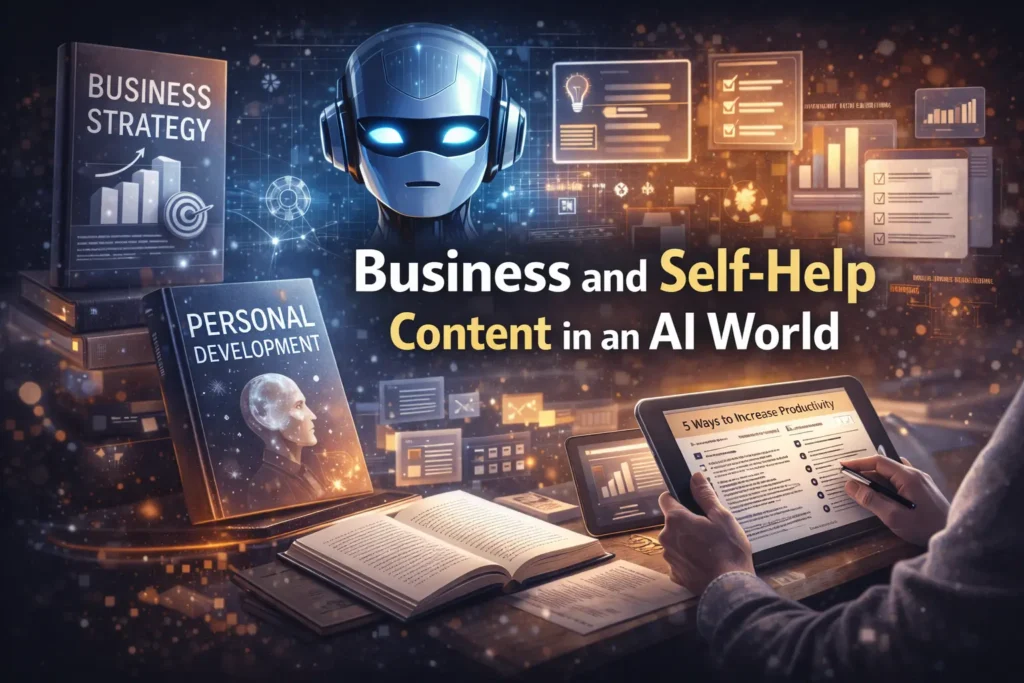
Beyond classrooms, AI is reshaping professional education and personal development. Many readers turn to business and self-help books for actionable frameworks and insights. AI can now extract those frameworks instantly, summarize key lessons, and convert them into step-by-step action plans. This impacts the commercial publishing industry significantly.
Authors and publishers must rethink value creation. Instead of selling information alone, they must provide experiences, credibility, and unique perspectives. High-quality thought leadership, live workshops, and interactive digital products may replace static content formats. In this evolving market, professionals seeking AI-powered learning solutions will gravitate toward platforms that combine automation with authenticity. The publishing ecosystem is shifting from content delivery to knowledge experience design.
Education at a Crossroads: Resistance or Reinvention
Educational institutions now face a defining choice. They can attempt to ban AI tools and preserve outdated evaluation systems, or they can adapt and innovate. The most forward-thinking schools recognize that AI is not the enemy it is a powerful educational partner. By integrating AI strategically, they enhance both teaching efficiency and student outcomes. This shift defines the next era of AI in education 2026.
Reinvention requires curriculum redesign and teacher training. Faculty must understand how AI tools work and how students are using them. Schools that invest in professional development and infrastructure will outperform those that delay adaptation. The transformation is not optional it is inevitable. The only question is how prepared institutions will be.
From Memory Testing to Critical Thinking
If AI can generate answers instantly, traditional recall-based exams lose relevance. Assessment must evolve toward reasoning, creativity, and real-world problem solving. This means incorporating debates, simulations, collaborative projects, and case studies into evaluation systems. Such changes align with emerging education technology trends.
Critical thinking becomes the ultimate competitive advantage. Students must learn how to question AI outputs, identify biases, and verify data accuracy. Teaching AI literacy alongside subject knowledge ensures balanced development. Rather than diminishing intellectual effort, AI can elevate it when used strategically. Education must transition from content memorization to applied intelligence.
Practical Strategies for Schools Adopting AI
To thrive in the AI era, institutions should consider the following actionable steps:
- Integrate AI literacy modules into core curricula
- Train educators on responsible AI implementation
- Shift assessment models toward application-based evaluation
- Invest in secure and scalable AI-powered learning platforms
- Establish ethical guidelines for AI usage
These strategies help schools leverage technology while maintaining academic integrity. Institutions that embrace innovation strategically will lead the future of learning.
The Future of Learning: A Balanced Ecosystem
The transformation of reading, writing, and learning is not about replacement it is about evolution. AI enhances accessibility, efficiency, and personalization across educational environments. However, human judgment, creativity, and ethical reasoning remain irreplaceable. The most successful institutions will build ecosystems where AI supports not substitutes—intellectual growth.
As we move deeper into AI in education 2026, the winners will be those who adapt quickly and thoughtfully. Educational leaders, policymakers, and entrepreneurs must collaborate to design systems aligned with technological realities. The goal is not to return to the old model but to build a smarter one. Learning will not disappear it will simply look very different.
Final Thoughts
Artificial intelligence is reshaping how we read, write, and learn at every level. The institutions that recognize this transformation early will shape the next generation of thinkers and leaders. By combining innovation with responsibility, education can become more personalized, efficient, and impactful than ever before.
If you’re exploring how to implement AI-powered learning solutions in your institution or organization, now is the time to act. The future of education is already here—are you ready to evolve with it?
FAQs
1. How is AI changing reading habits in 2026?
AI is transforming reading by enabling instant summaries, interactive explanations, and AI-generated audiobooks. Students can now ask questions about a text and receive contextual answers in seconds. This shift supports faster information consumption but also changes how deeply learners engage with content. Instead of linear reading, users explore ideas dynamically. The focus is moving from reading volume to comprehension and application.
2. Will AI replace traditional writing skills?
AI will not eliminate writing skills, but it is reshaping how writing is done. Tools powered by AI in education 2026 help generate drafts, refine grammar, and structure arguments efficiently. The essential skill now lies in prompting AI effectively and critically editing its outputs. Writers must add originality, insight, and strategic thinking to stand out. Human creativity remains a competitive advantage.
3. How should schools adapt to AI-powered learning platforms?
Schools should integrate AI literacy into their curriculum and redesign assessments to focus on reasoning rather than memorization. Investing in teacher training and secure digital infrastructure is crucial. Institutions must also establish ethical AI guidelines to prevent misuse. Embracing digital learning transformation ensures students are prepared for future workplaces. Resistance to AI adoption may widen the gap between traditional education and real-world demands.
4. Are AI-generated summaries harmful to student learning?
AI-generated summaries are not inherently harmful, but overreliance can reduce deep reading skills. When used strategically, they help students grasp core concepts quickly and clarify difficult material. The key is balancing efficiency with critical thinking. Educators should encourage students to verify AI outputs and engage with original sources. Responsible use strengthens learning outcomes rather than weakening them.
5. What skills will matter most in the future of AI-driven education?
Critical thinking, problem-solving, creativity, and AI literacy will be the most valuable skills. Students must learn how to evaluate AI-generated information and apply it effectively. Communication and collaboration remain essential in both academic and professional settings. Mastery of AI-powered learning solutions will differentiate future-ready learners. Adaptability will ultimately determine long-term success in an AI-driven world.