The Rise of AI Agents for HR in 2026
What if your HR department could operate with the speed of a startup, the intelligence of a data lab, and the precision of a machine that never sleeps? In 2026, AI agents for HR are transforming how organizations recruit, onboard, train, and retain talent. These systems do more than answer questions they execute workflows, integrate with enterprise systems, and continuously optimize outcomes. As labor markets grow more competitive and compliance becomes more complex, HR automation tools are no longer optional but essential. Leaders who embrace agentic AI in recruitment and workforce management are gaining a measurable edge in productivity and employee experience.
AI agents represent a fundamental shift from reactive HR operations to proactive, data-driven workforce strategy. Unlike traditional chatbots, agentic AI in HR software 2026 environments can trigger approvals, escalate sensitive issues, and manage multi-step processes autonomously. This evolution enables HR leaders to redirect administrative hours toward strategic planning, culture building, and innovation. By embedding intelligent HR workflows across the employee lifecycle, organizations unlock scalable performance improvements. The opportunity is not about replacing people, but about amplifying human decision-making with intelligent automation.
1. Agentforce for HR Service
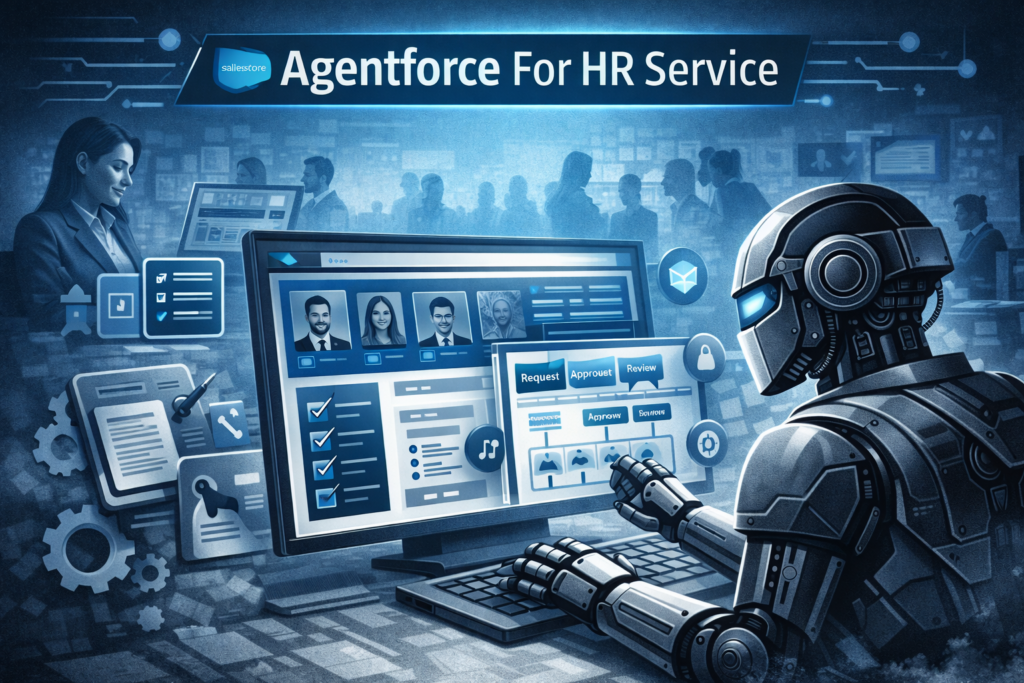
Agentforce for HR Service focuses on automating high-volume administrative processes that traditionally slow down HR departments. It supports onboarding documentation, employee case resolution, workforce policy guidance, and structured approval chains. The platform integrates directly with enterprise ecosystems, making intelligent HR workflows seamless across departments. By reducing manual intervention, HR teams can improve response times and consistency. This makes it a strong commercial choice for organizations scaling global operations.
Beyond efficiency, Agentforce strengthens compliance and audit readiness through structured documentation trails. AI agents for HR within the system monitor requests and escalate complex or sensitive issues to human specialists when necessary. This human-in-the-loop approach ensures accountability while still driving automation benefits. Enterprises looking for scalable HR automation tools often prioritize platforms with deep integration capabilities. Agentforce’s ecosystem alignment positions it as a practical solution for digital transformation initiatives.
2. Workday AI Agents
Workday’s approach to AI-powered talent management centers on a single data model that connects recruitment, payroll, and workforce planning. Its AI agents for HR can screen applicants, automate job changes, and surface predictive insights in real time. Because data consistency is built into the architecture, decision-making becomes faster and more reliable. Organizations benefit from a holistic workforce intelligence system. This makes Workday attractive for enterprises seeking predictive HR software 2026 solutions.
Strategically, Workday helps organizations shift from reactive hiring to long-term workforce planning. AI-driven analytics identify skills gaps and forecast staffing needs based on historical and real-time trends. HR leaders can use these insights to optimize recruitment budgets and internal mobility programs. Agentic AI in recruitment workflows reduces bias and improves candidate matching accuracy. Over time, this creates a measurable return on investment through improved talent retention.
3. ServiceNow HR Automation
ServiceNow’s HR automation tools connect HR with IT, facilities, and finance to streamline complex internal processes. AI agents for HR manage onboarding tasks, internal service tickets, and policy-related inquiries at scale. The platform’s strength lies in its ability to coordinate multiple departments without manual handoffs. This reduces delays and enhances employee satisfaction. Enterprises with fragmented systems often see immediate operational improvements.
The commercial value of ServiceNow comes from workflow transparency and measurable efficiency gains. Intelligent HR workflows eliminate bottlenecks and create traceable audit trails for compliance purposes. Agentic AI in recruitment and employee services enhances internal collaboration while maintaining oversight. As organizations expand globally, standardized automation becomes essential for consistency. ServiceNow provides a scalable infrastructure to support that growth.
4. Paradox (Olivia AI)
Paradox leverages conversational AI agents for HR to engage candidates instantly through messaging platforms. It screens applicants, answers role-specific questions, and schedules interviews automatically. High-volume hiring industries such as retail and hospitality benefit significantly from this speed. By automating early-stage recruitment, organizations reduce time-to-hire metrics. This positions Paradox as a leading agentic AI in recruitment solution.
Beyond speed, the platform enhances candidate experience through continuous engagement. Applicants receive real-time updates, reducing uncertainty and dropout rates. HR automation tools like Paradox free recruiters to focus on strategic talent evaluation. Over time, improved engagement strengthens employer branding and workforce quality. For organizations prioritizing recruitment efficiency, Paradox offers measurable commercial returns.
5. Moonhub
Moonhub’s AI agents for HR analyze resumes, match candidates to role requirements, and streamline early-stage vetting. Startups and scaling companies often lack large recruitment teams, making automation essential. The system accelerates pipeline development without compromising evaluation quality. This reduces operational overhead significantly. For competitive talent markets, speed becomes a strategic differentiator.
Moonhub also supports data-driven decision-making by highlighting candidate alignment metrics. HR leaders gain clarity on which profiles best match evolving organizational needs. Agentic AI in recruitment ensures consistency across screening processes. As hiring volumes increase, automation safeguards quality control. This makes Moonhub an attractive commercial solution for growth-focused businesses.
6. Beamery
Beamery’s intelligent HR workflows analyze employee skills, career trajectories, and organizational gaps. AI agents for HR recommend redeployment opportunities and learning pathways aligned with business objectives. This strengthens workforce resilience in volatile markets. Organizations can proactively address shortages before they impact productivity. Such predictive capability enhances long-term competitiveness.
From a strategic perspective, Beamery shifts HR from transactional hiring to skills-based planning. It enables internal mobility initiatives that reduce external recruitment costs. Agentic AI in HR software 2026 platforms like Beamery fosters data-driven leadership decisions. Businesses that prioritize skills intelligence often outperform competitors in innovation capacity. Over time, this creates sustainable workforce transformation.
7. Leena AI
Leena AI integrates with more than one thousand enterprise applications to centralize employee interactions. AI agents for HR manage benefits inquiries, leave requests, onboarding support, and compliance workflows. This reduces repetitive email chains and manual tracking. Employees receive instant responses, improving satisfaction rates. For global organizations, this consistency enhances operational reliability.
By acting as a single digital front door, Leena simplifies complex HR tech stacks. Intelligent HR workflows operate behind the scenes while presenting a unified interface to users. Agentic AI ensures structured processes are followed accurately. Organizations seeking modernization without replacing entire systems often choose this integration-first approach. The result is scalable automation with minimal disruption.
8. Lattice
Lattice deploys AI agents for HR to support goal setting, review cycles, and employee feedback analysis. Automation reduces administrative friction in performance management. Managers receive data-driven insights into engagement trends. Early detection of burnout risks allows proactive intervention. This strengthens organizational culture and retention.
The commercial advantage lies in improved productivity and talent retention metrics. AI-powered talent management tools help align individual goals with business strategy. Agentic AI highlights patterns that may otherwise go unnoticed. Over time, performance automation enhances leadership accountability. Lattice supports a people-first approach powered by intelligent analytics.
How to Implement AI Agents for HR Successfully
To maximize ROI from HR automation tools, organizations should follow a structured roadmap:
- Start with one measurable workflow
- Define clear KPIs such as time-to-hire or case resolution rate
- Maintain human oversight for ethical compliance
- Scale gradually after proven success
| Implementation Phase | Objective | Key Metric |
| Pilot Deployment | Automate one workflow | Time saved |
| Evaluation | Measure performance gains | Cost reduction |
| Governance | Ensure compliance | Audit accuracy |
| Expansion | Scale across departments | Productivity growth |
AI agents for HR are not about replacing professionals but about unlocking strategic potential. When deployed responsibly, intelligent HR workflows reduce costs, increase efficiency, and elevate employee experiences.
Final Thoughts: Building the Future of Intelligent HR
The future of HR in 2026 belongs to leaders who combine technology with purpose. AI agents for HR create scalable systems that drive measurable impact across recruitment, onboarding, and workforce planning. By blending automation with human insight, organizations can achieve sustainable transformation. Investing in agentic AI in recruitment and performance management today positions companies for long-term competitive advantage. The question is no longer whether to adopt AI HR software 2026 solutions, but how quickly and strategically you can implement them.
FAQs
1. What are AI agents for HR and how are they different from chatbots?
AI agents for HR are advanced automation systems that can execute multi-step workflows, integrate with enterprise platforms, and make rule-based decisions with minimal supervision. Unlike basic chatbots that only respond to queries, agentic AI in HR software 2026 environments can trigger approvals, schedule interviews, update employee records, and escalate complex cases. They operate with contextual awareness and continuous learning capabilities. This makes them significantly more powerful than traditional HR automation tools.
2. How can AI agents improve recruitment and hiring processes?
AI agents streamline recruitment by automating resume screening, candidate ranking, interview scheduling, and communication follow-ups. Agentic AI in recruitment reduces time-to-hire while improving candidate matching accuracy. By analyzing structured workforce data, these systems can identify top-performing profiles based on predefined criteria. HR teams benefit from reduced administrative workload and improved hiring consistency. Over time, this enhances both talent quality and employer branding.
3. Are AI agents for HR secure and compliant with data protection regulations?
Yes, leading AI HR software 2026 platforms are designed with enterprise-grade security and compliance frameworks. They include audit trails, role-based access controls, encryption standards, and human-in-the-loop oversight. However, organizations must still implement clear governance policies and ethical AI guidelines. Data privacy regulations such as GDPR and regional labor laws must be considered during deployment. Responsible implementation ensures automation enhances trust rather than compromising it.
4. What is the ROI of implementing AI agents in HR departments?
The return on investment from AI agents for HR can be measured in multiple ways, including reduced administrative hours, faster recruitment cycles, improved compliance accuracy, and higher employee satisfaction. Intelligent HR workflows decrease operational costs while increasing process consistency. Organizations often report measurable gains within the first few months of targeted deployment. The most successful implementations begin with high-volume, structured tasks. Long-term ROI grows as automation scales strategically across departments.
5. How should HR leaders start implementing AI agents?
HR leaders should begin with a clearly defined, repetitive workflow that delivers measurable value, such as onboarding documentation or employee self-service inquiries. Establish KPIs to track efficiency improvements and cost savings before scaling. Maintain human oversight to ensure ethical decision-making and accountability. Choose AI agents for HR that integrate seamlessly with existing systems. A phased, governance-focused approach ensures sustainable and secure transformation.