Introduction: Why Predictive Marketing Analytics Is Defining 2025
In 2025, marketing is no longer about reacting to customer behavior after it happens. It is about anticipating intent, timing, and needs before audiences even recognize them themselves. This shift is driven by advances in data science, AI leadership skills, and Digital innovation insights that allow organizations to move from descriptive insights to forward-looking intelligence. Businesses now compete on how accurately they can forecast demand, personalize experiences, and allocate resources with confidence rather than intuition. At the center of this evolution is predictive marketing analytics, which enables marketers to transform raw data into actionable foresight. Instead of guessing which campaign might work, leaders can model outcomes, predict customer lifetime value, and identify churn risks early. As Global business transformation accelerates and competition intensifies across borders, predictive approaches are becoming essential for Future-ready business leaders who want to build resilience, relevance, and sustainable growth.
Understanding the Core of Predictive Marketing Analytics
Predictive marketing analytics refers to the use of historical data, machine learning models, and statistical techniques to forecast future customer behavior. It goes beyond dashboards and reports by answering forward-looking questions such as who is most likely to convert, when a customer may disengage, or which channel will deliver the highest return. This approach helps organizations replace assumptions with evidence-based planning and smarter execution.
In 2025, the maturity of predictive tools means they are no longer limited to large enterprises. Cloud platforms, automated modeling, and integrated CRM systems have made predictive insights accessible to startups and mid-sized organizations as well. This democratization supports Startup growth strategies by enabling lean teams to compete with larger players using intelligence rather than budget size.
Data Foundations Powering Predictive Marketing Analytics
High-quality data is the backbone of any predictive strategy. In 2025, organizations are integrating first-party data from websites, apps, CRM systems, and customer interactions with contextual signals such as behavior patterns and engagement history. Clean, well-governed data allows models to learn accurately and deliver reliable forecasts that marketing teams can trust.
At the same time, responsible data practices are becoming central to brand trust. Companies are investing in transparent data governance and privacy-first design, aligning with Sustainable technology practices and Inclusive technology innovation. Predictive insights are only valuable when customers feel respected and protected, making ethical data stewardship a competitive advantage rather than a compliance burden.
AI and Machine Learning in Predictive Marketing Analytics
Artificial intelligence is the engine that drives predictive capabilities at scale. Advanced machine learning models continuously learn from new data, refine predictions, and adapt to changing market conditions. This allows marketers to respond to trends in real time rather than relying on static annual plans that quickly become outdated.
In 2025, AI-powered systems are also becoming more explainable, helping leaders understand why a prediction was made rather than treating it as a black box. This transparency strengthens Digital transformation leadership by enabling better collaboration between technical teams and business decision-makers. When insights are understandable, they are more likely to be trusted and acted upon.
Customer Journey Forecasting with Predictive Marketing Analytics
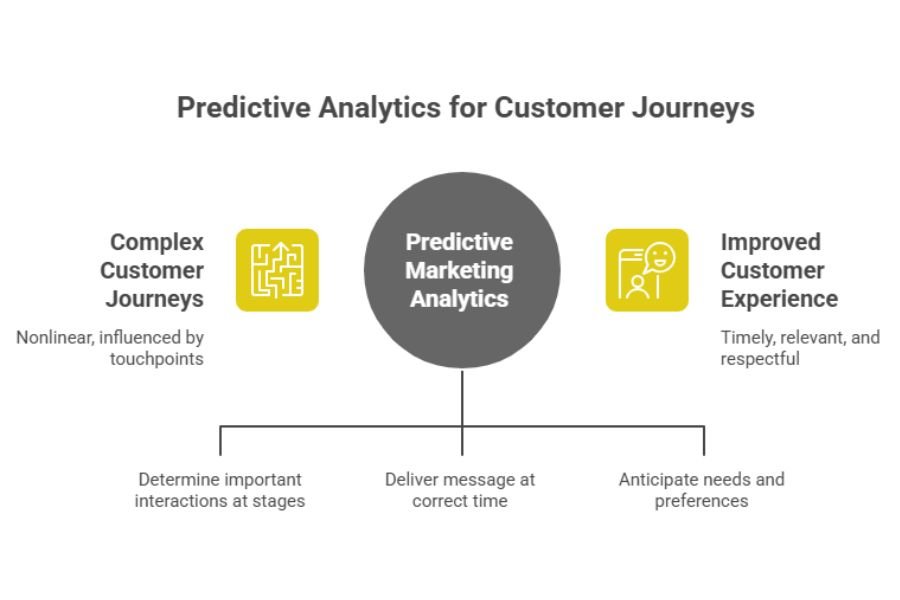
Modern customer journeys are complex, nonlinear, and influenced by countless touchpoints across channels and devices. Predictive marketing analytics helps organizations map these journeys dynamically by identifying which interactions matter most at different stages. This allows teams to intervene at the right moment with the right message, improving both conversion rates and customer satisfaction.
Journey forecasting also supports personalization at scale. By anticipating needs and preferences, brands can deliver experiences that feel timely and relevant rather than intrusive. This approach aligns with Technology for social impact by reducing noise, minimizing irrelevant messaging, and respecting customers’ time and attention in a crowded digital environment.
Predictive Marketing Analytics and Revenue Growth
Revenue growth in 2025 is increasingly driven by precision rather than volume. Predictive marketing analytics enables organizations to focus resources on high-value opportunities, optimize pricing strategies, and improve cross-sell and upsell effectiveness. By identifying which customers are most likely to respond, teams can increase ROI while reducing wasted spend.
This precision also strengthens alignment between marketing, sales, and finance. Shared predictive insights create a common language for forecasting performance and measuring impact. As a result, leaders can make confident investment decisions that support long-term Global business transformation rather than short-term wins.
Personalization at Scale Through Predictive Marketing Analytics
Personalization has moved far beyond using a customer’s name in an email. In 2025, it involves tailoring content, offers, and timing based on predicted behavior and intent. Predictive marketing analytics allows brands to create individualized experiences across channels without overwhelming teams with manual work.
This level of personalization supports Building innovation culture by encouraging experimentation and continuous learning. Marketers can test scenarios, learn from outcomes, and refine strategies in an ongoing feedback loop. The result is a marketing organization that evolves with its audience instead of chasing it.
Predictive Marketing Analytics in B2B and Enterprise Markets
In B2B environments, buying cycles are longer, stakeholders are more diverse, and decisions are more complex. Predictive marketing analytics helps organizations identify accounts most likely to convert, prioritize outreach, and align messaging with decision-maker intent. This approach improves efficiency and shortens sales cycles without sacrificing relationship quality.
Enterprise leaders are also using predictive insights to support Cross-border business expansion. By analyzing regional data and market signals, organizations can enter new markets with confidence and adapt strategies to local conditions. Predictive intelligence becomes a strategic asset for scaling globally while remaining locally relevant.
Risk Management and Predictive Marketing Analytics
Marketing risk in 2025 includes wasted spend, brand fatigue, and missed opportunities. Predictive marketing analytics helps mitigate these risks by identifying early warning signs such as declining engagement or shifting customer preferences. This allows teams to adjust strategies before problems escalate.
Risk management also extends to reputation and trust. Predictive tools can flag potential backlash or sentiment shifts, enabling proactive communication. For leaders focused on Technology for social impact, this foresight supports more responsible and empathetic engagement with audiences.
Building Teams Around Predictive Marketing Analytics
Technology alone does not deliver value without the right people and processes. Organizations succeeding in 2025 are investing in cross-functional teams that combine analytical skills with creative thinking. Data scientists, marketers, and strategists collaborate to translate predictions into meaningful action.
Mentorship for entrepreneurs and emerging leaders plays a key role here. By developing data literacy and strategic thinking, organizations build internal capability rather than relying solely on external vendors. This investment strengthens resilience and prepares teams for future shifts in Emerging tech trends 2025.
Ethical Considerations in Predictive Marketing Analytics
As predictive capabilities become more powerful, ethical considerations are increasingly important. Organizations must ensure that models do not reinforce bias, exclude communities, or manipulate behavior unfairly. Responsible use of predictive marketing analytics requires ongoing monitoring, diverse data sources, and human oversight.
Ethical leadership in this space strengthens brand credibility and long-term loyalty. By aligning predictive strategies with Inclusive technology innovation, companies demonstrate that growth and responsibility can coexist. This balance is essential for Future-ready business leaders navigating a complex digital landscape.
Measuring Success Beyond Short-Term Metrics
Traditional marketing metrics often focus on immediate outcomes such as clicks or conversions. Predictive marketing analytics encourages a broader view by connecting actions to long-term value, retention, and brand equity. This shift supports more sustainable decision-making and reduces pressure for short-term gains that undermine trust.
In 2025, success is measured by adaptability and learning as much as performance. Organizations that continuously refine models and strategies are better positioned to respond to change. Predictive insights become a living system that evolves alongside customers and markets.
The Strategic Advantage of Predictive Marketing Analytics in 2025
As competition intensifies, predictive marketing analytics is becoming a strategic differentiator rather than a nice-to-have capability. Organizations that embrace it gain clarity, confidence, and speed in decision-making. They move from reacting to trends to shaping them through informed action.
This advantage is particularly important for leaders driving Digital transformation leadership. Predictive insights help align innovation with business goals, ensuring technology investments deliver measurable impact. In a rapidly changing world, foresight becomes the foundation of sustainable success.
Turning Insight Into Impact
If you are ready to leverage data, foresight, and innovation to strengthen your marketing strategy, now is the time to act. Connect with Mustasam Abbasi to explore collaboration opportunities, speaking engagements, or consulting support at Mustasam Abbasi and start building a smarter, more future-ready approach to growth.
Conclusion
In 2025, marketing success is defined by foresight, relevance, and responsibility. Predictive marketing analytics empowers organizations to anticipate change, personalize experiences, and grow with confidence in an uncertain world. For leaders and teams willing to invest in insight-driven strategy, the rewards extend far beyond short-term performance. Whether you are refining your approach, scaling globally, or mentoring the next generation of innovators, now is the moment to embrace predictive thinking and connect with Mustasam Abbasi to turn vision into impact.
FAQs
What makes predictive marketing different from traditional analytics?
Predictive approaches focus on forecasting future behavior rather than analyzing past performance, enabling proactive decision-making.
Do small businesses benefit from predictive analytics in 2025?
Yes, cloud-based tools and automation have made predictive capabilities accessible and affordable for smaller teams.
How does AI improve marketing predictions?
AI models learn from data continuously, improving accuracy and adapting to changing customer behavior.
Is predictive marketing analytics ethical to use?
When implemented responsibly with transparency, privacy safeguards, and human oversight, it can be both ethical and effective.
What skills do marketing leaders need to succeed with predictive analytics?
Data literacy, strategic thinking, and the ability to translate insights into action are essential leadership skills.